What are the categories of pressure tanks?
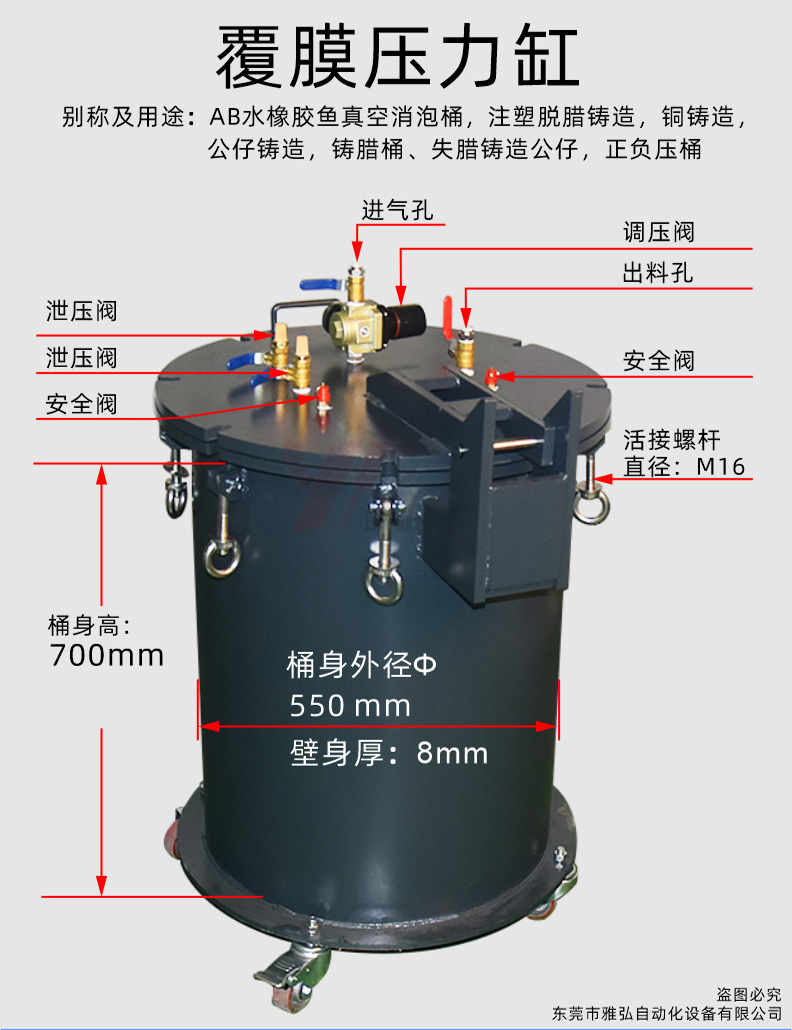
A standard pressure tank consists of an air pressure regulator, safety valve, ball valve, discharge outlet, inner tank, and four casters. This pneumatic stirring pressure tank features an air motor that can stir automatically, keeping the coating inside the tank uniform. During spraying operations, color differences caused by paint sedimentation are avoided. This product is not limited to coatings; other spraying materials can also be used. The pressure tank has a base, and the upper part of the base, i.e., the bottom inside the tank, contains a white stainless steel inner liner.
Working Principle
A standard pressure tank, also known as a material storage tank, is used to fill glue or fluid into the tank. Through pressure (connected to a pressure regulator for easy control of air pressure and to ensure constant pressure), the glue is pressed out to the required dispensing position.
Classification
Pressure tanks are classified by material into carbon steel and stainless steel. Carbon steel tanks, with a powder-coated exterior, are not recommended for direct filling with liquid materials. Instead, glue packaging barrels can be placed inside, or a stainless steel inner tank can be used for storage. Stainless steel tanks allow direct pouring of liquid materials for storage.
Stainless steel pressure tanks can be further categorized into 201, 304, and 316 materials.
The material selection for 201, 304, and 316 pressure tanks mainly depends on the composition of the liquid to be stored. For example, strong acids and alkalis require 316 material; thinner-type liquids require 304 material; while epoxy resins and silicones, commonly used in the dispensing industry, can use 201 material.
Stainless steel tanks include: standard pressure tanks, piston pressure tanks, cylinder-type piston pressure tanks, stainless steel heating tanks, carbon steel heating tanks, head pressure tanks, bottom-discharge pressure tanks, and dedicated dispensing pressure tanks, etc.
Precautions
During use, ensure that the union screw has locked the tank cover before normal operation. The safety valve must be in good condition; a damaged safety valve should not be used. It is best to replace the safety valve regularly to ensure safe use. If the glue is corrosive, it is optimal to use a 304 stainless steel pressure tank or a 304 inner tank.